

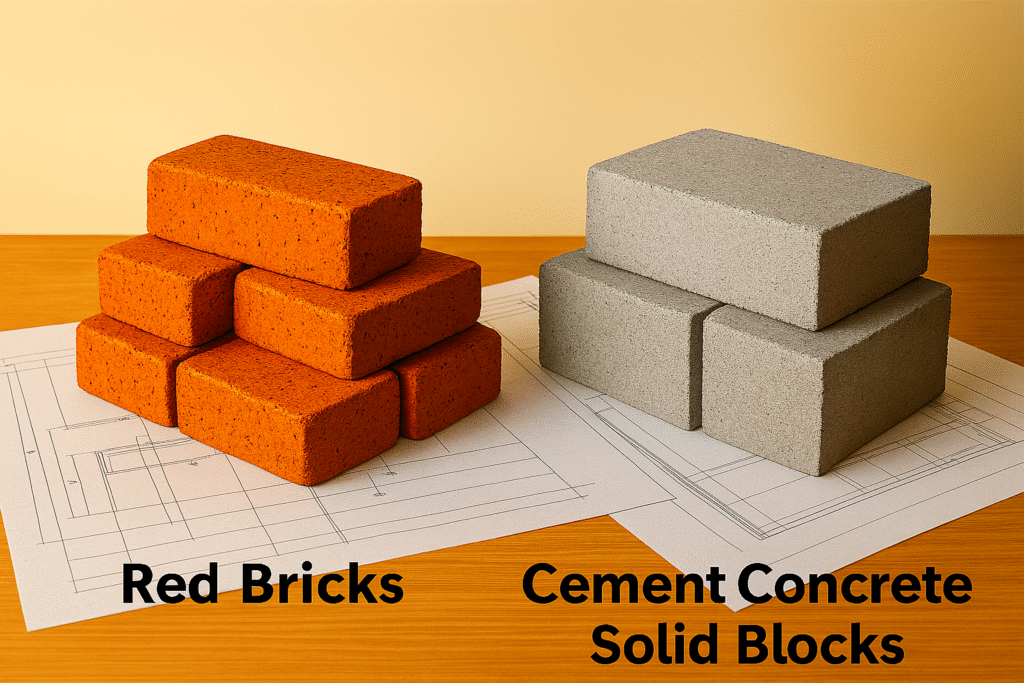
Red Bricks vs Cement Concrete Solid Blocks: Which One’s Right for Your Home?
It’s a question we hear often from homeowners: “Which bricks should we choose?” Should you follow the traditional route and opt for Red Clay Bricks, or go with the widely used Cement Concrete Solid Blocks that dominate modern construction?
However, the best choice depends on your site in Bangalore, budget, and long-term goals. This blog is designed to help you understand the key differences, so you can make an informed decision with confidence.
Red Bricks: The Traditional Favourite
Red bricks have been used in Indian constructions and in Bengaluru constructions for centuries. Made from clay and fired in kilns, they’re known for their classic look, rustic finish and time-tested durability.
It come in a standard-sized at 7.5″ × 3.5″ × 3.5″, these blocks are ideal for earthy construction and custom builds. Their natural insulation keeps interiors cooler in summer and warmer in winter. Easy to cut and shape, they’re often left exposed for a rustic, heritage finish. Widely available across Karnataka, especially in rural and semi-urban areas.
Red bricks increase construction cost due to higher material and labour charges. Their smaller size demands more cement mix and joint work, adding to build time. Traditional brick kilns have a high environmental impact, and breakage during transport leads to 5–10% site wastage. Poor laying can also cause thermal cracks in plastered walls over time.
Cement concrete solid blocks
Also known as solid concrete blocks or CMUs (Concrete Masonry Units)—are factory-made using a mix of cement, aggregates, and water. They’ve gained popularity in urban construction for their uniformity and speed of use.
Cement blocks come in standard sizes like 16″ × 8″ × 4″, 6″, and 8″, with a larger format that reduces the number of blocks needed per square foot—speeding up civil construction. Known for their high compressive strength, they’re ideal for load-bearing walls. Compared to red bricks, they’re more cost-effective, eco-friendlier (often made with fly ash or recycled materials), and result in lower site wastage due to factory-made uniformity and strength.
Things to Consider:
Cement blocks can retain heat, so proper insulation or plastering is essential for thermal comfort. They typically require plastering or cladding, as exposed finishes offer limited aesthetic appeal. Water absorption is slightly higher than red bricks, making waterproofing crucial for external walls
So… Which One Should You Choose?
There’s no one-size-fits-all answer. If budget is a concern, solid blocks offer budget friendly over red bricks. For exposed brick aesthetics, red bricks are the clear winner; for faster, more uniform construction, solid blocks deliver. Site conditions like soil type, load-bearing needs, and climate also play a role. If sustainability matters, fly ash-based blocks are a greener choice. And if your site has limited space or you want crack-free plastered walls, solid blocks may offer better consistency with lower wastage.