

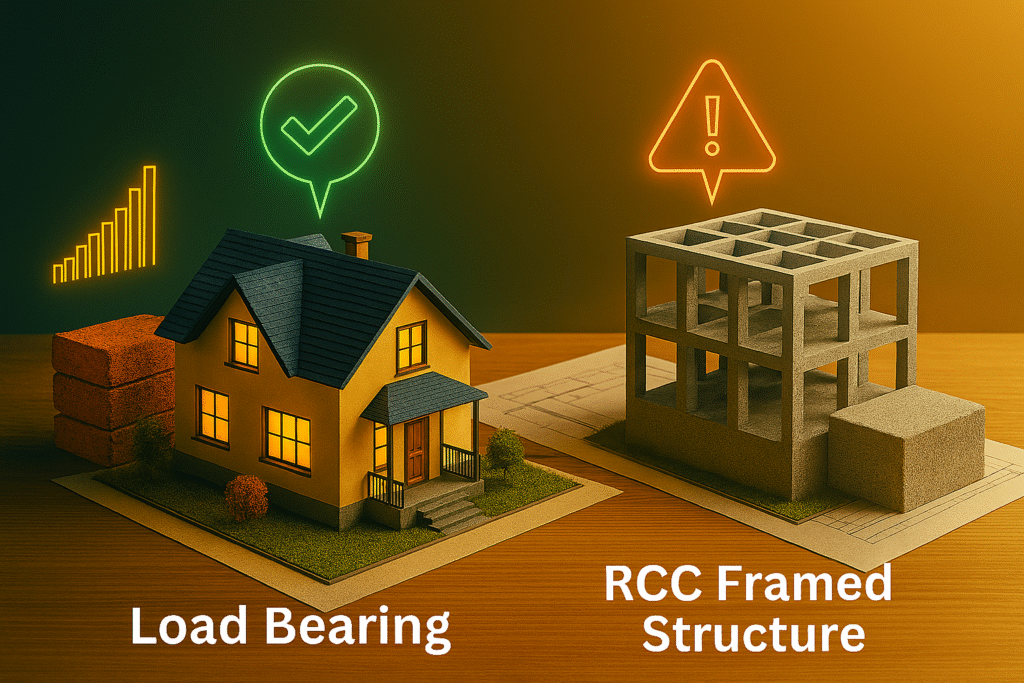
Load Bearing vs RCC Framed Structures — which one to opt for?
When building a home in Bengaluru, one of the first decisions is choosing the right type of structure. Two common options are Load Bearing and RCC Framed structures — each with its own advantages, limitations, and suitability depending on your plot size, budget, and future plans.
A load bearing structure relies on thick masonry walls to carry the entire weight of the building. These walls transfer the load directly to the foundation; no beams or columns are used.
What would be the construction impact?
- Requires large quantities of bricks or blocks
- Walls are typically 9 inches to 18 inches thick
- Consumes more space, reducing usable carpet area
- Needs stronger foundations for 3 storey –4 storey buildings and less flexible in design
Best suitable for budget-friendly, low-rise homes in semi-urban or rural areas — like Ground+1 or Ground+2 houses
However, there are certain challenges and limitations, the Door frames and partition walls must be fixed into structural walls, openings and room layouts must be planned in advance, difficult to modify or expand later, less resistant to earthquakes compared to RCC
An RCC (Reinforced Cement Concrete) framed structure uses concrete beams, columns, and slabs to carry the load. The walls are non-structural and act as partitions.
What would be the construction impact?
- Uses cement, steel rods, and concrete
- Walls are thinner, increasing usable carpet area
- Supports multi-storey buildings with better load distribution
- Faster construction with proper engineering
Best suitable and works for modern, flexible and urban constructions, like multiple storey residential buildings, villas, duplex homes, and apartments, commercial buildings, hospitals, and malls etc…
This gives flexibility, walls and door frames can be moved or resized, more carpet area, Ideal for modern layouts and future expansion